
Tips & TRicks
10 Tips for dating
Long Distance Relationship
- Establish financial boundaries early. Discuss family support expectations (utang na loob) openly within the first months. Agree on a fixed, sustainable amount. Frame it as learning, not interrogation.
- Learn the cultural vocabulary. Study hiya, pakikisama, utang na loob, and amor propio as operational values, not scam mechanisms. Learn basic Tagalog/Bisaya to signal respect.
- Define family integration expectations. Ask about family structure, breadwinners, and what role the family expects from a foreign son-in-law. Understand you are joining a family, not just dating an individual.
- Use video calls to read high-context cues. Filipino communication is indirect; meaning lives in tone, silence, and what is unsaid. Text strips these away. Probe gently when words and expressions don’t match.
- Visit multiple times before relocating. At least two to three visits of increasing length. Meet the family, observe daily life, and watch for immediate aggressive financial requests versus gradual, contextual ones.
- Address the age gap openly. Gaps of 20+ years carry specific risks: different life stages, health, social perception. Discuss 10/20/30-year visions honestly.
- Avoid the “rescuer” identity. Examine whether you’re attracted to the person or to being needed. Encourage her autonomy, education, and goals independent of you.
- Understand the economic context without condescension. 63% of Filipino families self-identify as poor. Familial support is often survival, not greed. Listen with empathy; set limits with clarity.
- Plan relocation logistics concretely. Agree on housing (with family, near them, or independent), visa status, income source, and a contingency plan if things go wrong.
- Build an independent support network. Connect with expat communities, local friends, and balanced online forums. Do not let your partner’s family become your sole social world.
Dating once arrived
- Acknowledge the power asymmetry. Your wealth, age, and nationality create an uneven field. Avoid leading with displays of wealth. Opt for simple dates initially; observe whether she engages with you or your resources.
- Meet the family early—but observe. Accept invitations within weeks. Be respectful, bring a small gift. Watch the family dynamic: warmth or assessment? Transparency or immediate financial hints?
- Respect hiya in conflict. Avoid direct confrontation. Use “I” statements, allow silence, give processing time. Never criticize her or her family publicly.
- Negotiate financial support as a couple. Create a joint financial plan. Agree on a fixed amount or specific obligations. Review periodically. Address escalation as a boundary issue, not a character accusation.
- Learn the local language. Even 200–300 words shift the power dynamic, reduce dependency, and signal genuine commitment to her world.
- Distinguish cultural practice from individual manipulation. Ask: Is this request consistent with Filipino norms, or excessive and guilt-driven? Is she transparent about where money goes? Does the family show gratitude or entitlement?
- Integrate into the community. Attend fiestas, participate in bayanihan, learn extended family names. Move from “wallet” to genuine community member.
- Address gender roles explicitly. 83% of Filipinas find homemaking fulfilling; traditional roles are the norm. Discuss expectations openly: sole earner, shared duties, career ambitions. Unspoken assumptions breed resentment.
- Protect your legal/financial position. Consult a Philippine lawyer before major commitments (property, loans, transfers). Understand foreign ownership rules and marriage vs. cohabitation implications. This is due diligence, not distrust.
- Give the relationship time. Resist acceleration. Let it pass through the honeymoon phase, first disagreement, first family obligation, first financial stress. Duration reveals character.
Age gap relationship
1. Why Some Filipinas Are Drawn to Older Western Men
The motivations are layered and vary enormously from person to person:
Family-structure factors
The Philippines has a significant rate of absent fathers (due to OFW labour migration, separation, or abandonment). Psychologists and Filipino sociologists (e.g., work from the University of the Philippines’ Department of Psychology) note that some women develop what is colloquially called a search for a father-figure partner – someone who projects stability, protection, and emotional presence they lacked growing up.
This is not universal, but it is a recognised thread in relationship counselling literature in the Philippines.
Economic and practical security
The Philippine minimum wage (roughly ₱600/day in Metro Manila, less in provinces) makes genuine financial security difficult. An older Western man with a pension or steady income can represent a path out of poverty – not just for the woman, but often for her extended family (utang na loob and family obligation are deeply embedded cultural values).
This doesn’t automatically mean the relationship is transactional, but economic asymmetry is a real starting condition.
Cultural perceptions of maturity
Filipino courtship culture (panliligaw) traditionally values a man who is serious, provider-oriented, and settled. An older man is often read as embodying those traits more readily than a younger one.
Western men, in particular, are sometimes perceived (fairly or not) as more egalitarian in domestic life, less prone to the machismo and infidelity patterns some Filipino women report experiencing with local partners.
Genuine attraction and compatibility
It’s important not to reduce every such relationship to economics or psychology. Many couples report shared values, humour, intellectual connection, and authentic love. Age is one variable among many.
2. Advantages Often Cited
Financial stability: A pension, savings, or foreign income can provide housing, healthcare, and education opportunities that would otherwise be out of reach, benefiting the couple and often the woman’s family.
Emotional maturity: Older partners may be less prone to jealousy games, more patient, and more communicative – qualities valued in a culture where pakikisama (smooth interpersonal relations) matters.
Cultural exchange: Both partners can gain language skills, broader worldviews, and cross-cultural family networks.
Commitment orientation: Many older expats are past the “playing the field” stage and actively want a stable domestic life, which aligns with what many Filipinas seek.
Legal pathways: Marriage can open immigration options (13A visa in the Philippines, or spousal visas to the West), giving the Filipina greater mobility.
3. Risks and Criticisms
Power imbalance: Large gaps in age, wealth, and citizenship status create structural inequality. The younger partner can become dependent, making it hard to leave a bad situation.
Exploitation and trafficking concerns: The Philippine government (through the Inter-Agency Council Against Trafficking) and NGOs flag that a minority of these arrangements shade into sex tourism, coerced relationships, or mail-order-bride dynamics. Not every age-gap couple falls here, but the ecosystem that normalises the pattern can also shelter exploitation.
Social isolation: A young Filipina who marries and moves abroad can be cut off from her family network, which is a profound loss in a culture where family ties are central.
Health and caretaking asymmetry: A 25-year-old woman married to a 65-year-old man may realistically face a decade or more as a caretaker in her 30s and 40s.
Cultural and generational friction: Differences in values around religion (the Philippines is ~80% Catholic), family obligations, gender roles, and social life can create persistent tension.
Stigma of the “gold-digger” narrative: The woman often bears a disproportionate share of social judgement, being labelled gold-digger or, harsher, prostitute, regardless of her actual motives.
Legal vulnerability: If the relationship is not formalised, or if the foreign partner controls finances and documents, the Filipina can be left with very little recourse under Philippine law.
4. Philippine Society’s View: Acceptance, Ambivalence, and Resistance
The picture is genuinely mixed:
Relative tolerance
Compared to many East Asian or Middle Eastern societies, the Philippines is fairly pragmatic. Family approval often hinges on whether the man is seryoso (serious), respectful to the family, and financially reliable. If he shows up to family gatherings, contributes, and treats the woman well, many families accept and even welcome the match.
There’s a long history of Filipino-American couples going back to the US military presence (Subic Bay, Clark), which normalised the visual of a mixed, age-gap couple in certain regions.
Underlying discomfort and stigma
Among urban, educated, and middle-class Filipinos, there is often a quiet discomfort. The relationship may be tolerated but whispered about. The woman may be assumed to be “with him for the money” regardless of the truth.
The Catholic Church’s emphasis on marriage as a sacrament between equals adds a moral lens that can frown on relationships perceived as transactional.
Social media and Filipino pop culture frequently mock or pitify such couples, reinforcing stereotypes.
Regional variation
In former military-base towns (Angeles, Olongapo) and heavy tourist areas, these relationships are so common they carry less shock value, though also more association with the sex industry.
In more conservative, rural, or strongly Catholic communities, the age gap and foreign element can draw more open disapproval.
Generational shift
Younger, urban Filipinos (Gen Z, millennials) increasingly push back against the “provider” model and favour partnerships of equals, though economic realities still shape choices.
There is growing public discourse (Filipino YouTube, podcasts, op-eds) critically examining the power dynamics rather than simply normalising or condemning them.
5. A Balanced Frame
The honest summary is that this phenomenon sits on a spectrum:
At one end, two adults of very different ages and backgrounds build a genuinely loving, respectful partnership. This exists and deserves no special suspicion.
At the other end, poverty, lack of opportunity, and foreign privilege produce relationships that are functionally exploitative, even if no law is technically broken.
Most real couples fall somewhere in the messy middle, with mixed motives on both sides – affection and pragmatism, love and calculation, in proportions that shift over time.
What tends to predict whether such a relationship is healthy or harmful is less the age gap itself and more:
whether both partners entered it with informed, un-coerced consent,
whether the younger partner retains financial literacy, legal standing, and family ties,
whether there is mutual respect rather than a patron–dependent dynamic,
and whether the older partner integrates into the Filipino family and culture rather than treating the Philippines as a service economy.

Banking in the Philippines
What Actually Happens When You Walk Into a Branch
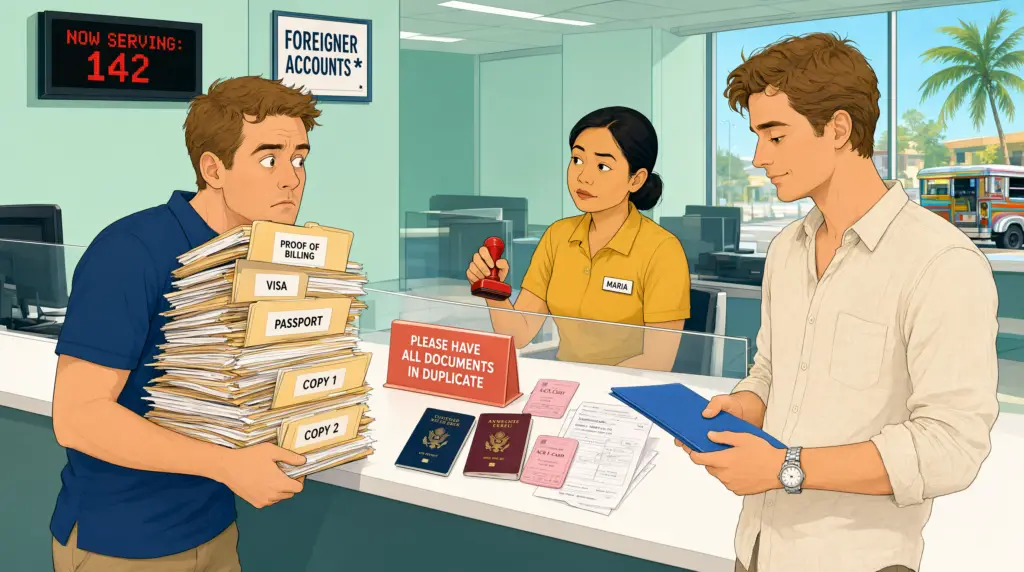
What You’ll Need to Bring
The Tourist Problem
The American Problem (And Why It’s Worse Than You Think)
The European Experience: Noticeably Smoother
A Few Practical Tips
- Go to a big-city branch. Makati, Bonifacio Global City, Cebu City. Staff there handle foreigners regularly. Rural branches may never have processed a foreign application.
- Go early in the morning. Lines get long. Patience runs thin by 2 PM.
- Bring a Filipino friend or colleague if your Tagalog is shaky. Not required, but it smooths every interaction.
- If you’re American and get turned away, try a different branch the next day. Or try a different bank entirely. Security Bank and Metrobank sometimes prove more flexible than BPI.
- USD savings accounts exist at most major banks if you want to park dollars and avoid converting to pesos. Interest is tiny — sometimes near zero — but the account itself is straightforward to open.
The Bottom Line
Healthcare and Health Insurance
Dating a separated woman
Is she legally married?
I read a lot of questions about relationships and dating here. One important legal aspect is often overlooked: Is she legally married?
 Divorce is not possible in the Philippines (except for Muslims). Even if a couple has a legal court separation, they are still legally married in the eyes of the law.
A lot of women are legally married but separated. Most of the times you can have a good relationship with them without any problems. The legal husband is gone and doesn’t care, and she doesn’t care for him.
But this relationship is technically illegal. If a legally married woman has a sexual relationship with another man, it is considered ADULTERY. This is a criminal offense. Adultery is illegal for women and can be punished. Adultery doesn’t exist for the man, but he can be accused as an accessory.
The legal consequences are severe. If the case goes to court, both the woman and her foreign partner can be convicted. A conviction carries a prison sentence and a fine. For a foreigner, this also means deportation after serving the sentence. .
The good news is that it is a “PRIVATE CRIME”. The police will not arrest you on their own. The legal husband must be the one to file the criminal complaint. But here is the real-world risk: This law is often used for blackmail. If you know that the ex is still around, lives not too far, or his family lives close by, you can be a target. If the husband is angry, jealous, or just wants money, he or his family can threaten to file an adultery case against you unless you pay “hush money”, or just to embarrass you and ruin your reputation. I know of expats who have been dragged into long, expensive legal battles because they assumed a “separated” status was enough.
If you want to be absolutely sure that there is no risk, ask her for a CENOMAR. This is a “Certificate of No Marriage” issued by the Philippine Statistics Authority (PSA). It shows her official civil status. She might be shy to tell you about her real situation, but this document gives you the facts. Don’t take the risk. If the CENOMAR shows she is still married, do not move in together or start a physical relationship until her annulment is fully finalized by a court. It takes time and money, but it is the only way to be 100% safe.
Moving Money to the Philippines
- Direct Bank Transfers You can wire money directly from your foreign bank to a Philippine bank account. However, this is often not the most cost-effective method. Sending banks frequently charge high outgoing wire fees, and the exchange rates they offer are usually poor, meaning you lose a significant amount of money on the conversion.
- ATMs and Cash Withdrawals Using your foreign debit card at a local ATM is convenient but comes with costs. Philippine ATMs charge a standard 250 PHP access fee for foreign cards. Additionally, most machines limit withdrawals to just 10,000 PHP per transaction, though a few allow up to 20,000 PHP. On top of the local fee, your home bank may charge international withdrawal fees. Pro tip: If you are from the US, look into banks like Charles Schwab, which reimburse all global ATM fees, effectively wiping out the 250 PHP charge.
- Opening Bank Accounts and E-Wallets To integrate into the local economy, you’ll want a local bank account. Traditional banks generally require an Alien Certificate of Registration (ACR) I-Card. The good news is that most nationalities, including US citizens, can open these accounts with an ACR I-Card and passport.
- What about GCash? Yes, it is possible to open a basic GCash account without an ACR I-Card using just your passport. However, to become fully verified—which gives you higher transaction limits and access to all features—you will eventually need to provide your ACR I-Card.
- Digital Transfer Services: Wise and Remitly For moving money from your home country, digital apps are your best friends. Wise allows you to hold money in various currencies. You can keep your funds in USD and exchange them to PHP only when the rate is favorable. You can then transfer directly to a Philippine bank or withdraw with a Wise ATM card for a small fee.
- Remitly is another fantastic digital remittance platform. It offers “Express” for instant transfers and “Economy” for lower fees. Remitly allows you to send money to a Philippine bank, directly into a GCash wallet, or for cash pickup at local partner outlets.
- Western Union If you are traveling to remote provinces or need to send cash to someone without a bank account, Western Union is still king. You can send money from your home country, and the recipient can withdraw it in physical cash at thousands of partner offices across the Philippines.
Understanding Age of Consent and Relationship Laws in the Philippines
When it comes to dating and relationships in the Philippines, many expats rely on outdated information or look for technical loopholes. A common and highly risky mindset is targeting individuals who have just turned 18, assuming that hitting the legal age provides a blanket of protection.
As highlighted in a recent, highly informative video by content creator Dee, deliberately aiming for the lowest possible legal age raises serious legal red flags and can lead to severe consequences, including long prison sentences.
If you are an expat navigating the dating scene in the Philippines, it is crucial to understand the actual laws, the hidden legal traps, and the practical steps you need to take to stay out of trouble.
The New Age of Consent: RA 11648
For a long time, the age of sexual consent in the Philippines was 12. This changed in March 2022 when **Republic Act No. 11648** was signed into law, raising the age of consent to **16**.
Under the amended Article 266-A of the Revised Penal Code, any sexual act with a person under the age of 16 is considered **statutory rape**.
- Consent does not matter:
It does not matter if the person looked older, claimed to be 18, or even showed a fake ID. - Ignorance is not a defense:
Claiming “I thought she was older” will not protect you in court. The law expects you to verify a person’s age properly. - The Penalty:
The penalty for statutory rape is *reclusion perpetua* (20 to 40 years in prison). It is considered a non-bailable offense, and cases can take years to resolve.
The “Close-in-Age” Exemption Myth
RA 11648 introduced a close-in-age exemption, which states there is no criminal liability if the age gap is 3 years or less, the younger person is at least 13, and the relationship is consensual and non-exploitative.
Do not rely on this rule. This exemption was designed to protect teenage high school couples. It does *not* protect a 50- or 60-year-old foreigner with a massive age gap. Courts look at power dynamics, and a large age gap combined with foreign status will heavily raise concerns about exploitation.
Hidden Legal Traps for Ages 16 to 18
Reaching the age of 16 (or even 18) does not remove all legal risks. Other laws continue to protect young people, and families in the Philippines are notoriously close-knit and protective. If a relationship ends badly, relatives may use these laws to take legal action:
- Child Abuse and Exploitation (RA 7610):
Section 10(b) of this law makes it a crime to keep a minor (under 18, specifically 12 or under, *or* someone 10 years younger than you) in your company in hotels, motels, resorts, or bars, unless you are a close relative. The penalty includes up to 12 years in prison and heavy fines. A 60-year-old expat with an 18-year-old in a resort can be reported by hotel staff and face immediate investigation and immigration issues. - Qualified and Simple Seduction (Revised Penal Code Articles 337 & 338):
These laws apply to individuals aged 16 to under 18. They make it a crime to initiate a sexual relationship using deceit, false promises of marriage, or abuse of authority/trust.
Practical Tips to Stay Safe and Legal
To avoid legal nightmares and ensure you are building a healthy relationship, D recommends the following practical steps:
- Verify Age Properly:
Never rely on appearance or verbal claims. Ask to see a valid government ID or a PSA Birth Certificate. - Look for Maturity, Not Just Legal Age:
A 25-year-old with life experience and responsibilities is vastly different from an 18-year-old whose main experience is school and barangay life. Seek a partner who can communicate and handle problems on equal footing. - Avoid Exploitative Optics:
Avoid situations that could look exploitative, such as taking a much younger partner to hotels or resorts, which can trigger mandatory reporting under RA 7610. - Be Honest About Expectations:
Be upfront early on about finances, family involvement, and future plans. - Beware of Exploitative Families:
Unfortunately, some families may try to “pimp out” their daughters to foreigners for financial gain. If a situation feels like it is pushing legal or ethical lines, step away immediately.
Final Thoughts
The 2022 law updates provided clearer protections for the youth, but many expats still arrive without understanding the full scope of the rules. Stop searching for technical loopholes or the lowest legal age. If you want a stable, safe, and happy life in the Philippines, build your relationship on mutual respect, honesty, and maturity.
Credits & Legal Resources
This article is based on the insights and practical advice shared by Dee in their recent YouTube video. If you want honest, practical information about life in the Philippines, be sure to check out their channel.
Relevant Legal Information:
- Republic Act No. 11648 (Raising the Age of Sexual Consent to 16):** [Read the full text on the Official Gazette](https://www.officialgazette.gov.ph/2022/03/11/republic-act-no-11648/)
- Republic Act No. 7610 (Special Protection of Children Against Abuse, Exploitation and Discrimination Act):
[Read the full text on the Official Gazette](https://www.officialgazette.gov.ph/1992/06/17/republic-act-no-7610/) - The Revised Penal Code of the Philippines (Articles 266-A, 337, 338):** [Read the full text on the Official Gazette (https://www.officialgazette.gov.ph/1930/09/20/act-no-3815/)
The real danger for expats: murder & kidnapping versus trafic
Is the southern Philippines really more dangerous for foreigners?
Analyses made with the help of AI
Download the whole analysis
I dug into the actual data on crimes against foreigners in the Philippines over the last 5 years — kidnapping, murder, terrorism — and compared the Muslim regions of Mindanao and the Sulu Islands to national stats, then to the USA and Western Europe, then to something most people never think about. Here’s what I found.
1️⃣ THE THREAT IN THE SOUTH IS REAL BUT SPECIFIC
Kidnappings of foreigners in the Sulu Archipelago, Basilan, Tawi-Tawi, and parts of Zamboanga are documented across police data, conflict monitors (ACLED), travel advisories, and journalism. Abu Sayyaf and POGO-linked syndicates are the main perpetrators. This is not media hype.
BUT: murders of foreigners are extremely rare (single digits per year nationally) and NOT concentrated in Muslim regions. The kidnapping risk is geographically narrow — specific islands and coastal areas, not all of BARMM.
2️⃣ COMPARED TO THE USA AND WESTERN EUROPE
→ Homicide rate: Philippines (5/100k) ≈ USA (5-6/100k) and about 5-8x higher than Western Europe (~0.6-1.4/100k).
→ Kidnapping of foreigners: This is where the gap is enormous. The USA and Western Europe have NO equivalent of an armed group systematically abducting foreigners for ransom. The baseline risk there is essentially zero. The southern Philippines is infinitely more dangerous on this specific crime — but the absolute probability for any individual remains low.
→ Media amplification inflates perceived danger, but it responds to a real, documented pattern. It’s not fabricated.
3️⃣ THE PLOT TWIST: THE REAL KILLER ISN’T TERRORISM. IT’S TRAFFIC.
This is the finding that surprised me most.
→ A foreigner in the Philippines is roughly 20 to 50 times more likely to DIE in a road accident than to be murdered.
→ Roughly 100 to 500 times more likely to be seriously INJURED in traffic than to be kidnapped.
→ Estimated 50-100+ foreigners die in Philippine road accidents per year. Murders of foreigners: 1-5. Kidnapping deaths: 0-2.
The killers are rented motorcycles without helmets, jeepneys hitting pedestrians in Manila, overloaded ferries, unlit provincial roads at night. Even in high-risk Mindanao areas, the road and maritime accident risk rivals or exceeds the kidnapping risk.
4️⃣ THE BOTTOM LINE
Yes, the southern Philippines carries a real, specific kidnapping risk that doesn’t exist in the West. It warrants precautions. But it’s narrow, geographically bounded, and statistically small for any individual.
The dangers that actually kill foreigners here are mundane: traffic, scooters, boats, bad roads.
Travel advisories warn you about Abu Sayyaf. Nobody warns you about crossing EDSA on foot or renting a scooter in Siargao with no experience.
The road is more dangerous than the insurgent.
━━━━━━━━━━━━━━━━━━━━━━
⚠️ Sources: PNP crime data, ACLED conflict database, WHO road safety reports, US/Canadian/EU travel advisories, Philippine Statistics Authority, Rappler, Inquirer, GMA News, Eurostat, FBI UCR. Data limitations apply — the Philippines lacks a centralized database disaggregating crimes by victim nationality.
Short tips & Tricks
Mastering the "Palengke" (Wet Market) vs. Supermarkets
- Freshness and Quality: Meat and fish at the palengke are often slaughtered or caught that very morning. Supermarket meat is usually chilled, frozen, or imported. For fresh catch and farm-to-table vegetables, the wet market is unbeatable.
- Pricing and the “Tingi” Culture: You can easily save 20% to 40% on vegetables, fruits, and local meats at the wet market. Furthermore, the palengke is the heart of the “tingi” (retail/sachet) economy. You can buy a single clove of garlic, one egg, or 50 pesos worth of cooking oil, which is perfect for minimizing food waste.
- Haggling and the “Suki” System: Haggling is expected, but it must be done politely and with a smile. However, the real secret is building a relationship with a vendor to become their suki (loyal patron). Once you are a suki, they will reserve the best cuts of meat for you, give you automatic discounts, and throw in free extras (like a sprig of spring onions or a piece of ginger) without you even asking.
Hiring Domestic Help (Kasambahay) the Right Way
- Minimum Wage: You must pay at least the regional minimum wage for domestic workers, which is determined by the Regional Tripartite Wages and Productivity Board. As of 2026, in the National Capital Region (NCR), this is upwards of PHP 7,000 to PHP 8,000 per month, and slightly less in provincial areas.
- Mandatory Benefits: By law, you must provide a 13th-month salary (usually given before Christmas), a minimum of five days of Service Incentive Leave per year, and at least 24 consecutive hours of rest per week.
- Government Contributions: As an employer, you are legally required to register your helper and share the cost of their SSS (Social Security), PhilHealth (national health insurance), and Pag-IBIG (Home Development Mutual Fund) contributions. You must also provide them with an Employment Contract and an Employer’s Record.
Surviving Brownouts and Water Interruptions
- Power Solutions: Invest in a good Uninterruptible Power Supply (UPS) for your router and computers to keep you online during short blips. For longer outages, many expats are now investing in portable power stations (like EcoFlow or Bluetti) or even small solar setups with deep-cycle batteries, as the Philippines has some of the highest electricity rates in Asia.
- Water Security: If you rely on a local water district or a deep well, install a large water reserve tank (at least 500 to 1,000 liters) paired with an automatic pressure pump. This ensures you have water for flushing toilets and showering when the main supply cuts out.
- Lighting and Cooling: Keep rechargeable LED lanterns and flashlights in every room. A good battery-operated or rechargeable fan is also a lifesaver when the air conditioning dies during a blackout.
Internet and Connectivity: PLDT, Globe, Converge, and Starlink
- Fiber vs. Mobile: Always get a wired Fiber connection for your home. Mobile data (Smart/Globe/DITO) is great for on-the-go but can suffer from severe congestion in densely populated areas or during heavy rains.
- Customer Service: Be prepared for slow customer service, automated phone trees, and occasional technician no-shows. Patience and a thick skin are required. If a technician doesn’t show up, you often have to re-ticket the issue.
- Starlink: If you are living in a remote province, a beachfront property, or on an island where fiber hasn’t reached, Starlink is an absolute game-changer. As of mid-2026, the standard residential service costs PHP 4,099 per month, with the hardware kit usually priced around PHP 18,000 to PHP 20,000 (though they frequently run promotions). It is more expensive upfront but offers unparalleled, low-latency reliability anywhere with a clear view of the sky.
Driving in the Philippines: LTO, Grab, and Tricycles
- Ride-Hailing: Grab is the dominant ride-hailing app, offering safe, reliable, and air-conditioned transport. Use it in major cities to avoid the hassle of parking and haggling. In some areas, local alternatives like JoyRide or Move It are gaining traction.
- Tricycles & Jeepneys: These are the lifeblood of provincial transport. Always agree on the fare with a tricycle driver before getting in if there is no meter or posted rate.
- Getting a License: Foreigners can drive using a valid home-country license for the first 90 days of entry. After that, you must convert it to a Philippine driver’s license at the Land Transportation Office (LTO). The LTO has recently digitized many of its processes, but expect to spend a full day dealing with the theoretical and practical exams, medical checks, and biometrics.
Typhoon and Disaster Preparedness
- Supplies: Keep at least 3 to 5 days’ worth of non-perishable food, bottled water (at least 3 liters per person per day), and any necessary prescription medications.
- Documents: Keep physical and digital copies of your passport, visa, ACR I-Card, insurance policies, and property deeds in a waterproof, fireproof bag or cloud storage.
- Power & Cash: Have fully charged power banks and enough physical cash to last a week. ATMs, credit card terminals, and GCash servers will not work during a widespread power or cell tower outage.
Navigating the "Notary Public" and Bureaucracy
- The Process: You usually need to print the document (often in triplicate), bring a valid government ID, and appear in person before the notary.
- Cost: Notarization is surprisingly cheap, usually ranging from 100 to 500 PHP per document, though lawyers in high-end business districts like BGC or Makati may charge more.
- Apostille: If you need to use a Philippine public document abroad (or vice versa), you will need to get it authenticated via the Apostille process. The Department of Foreign Affairs (DFA) now handles this primarily through an online appointment system, which can be tricky to secure, so book well in advance.
Shipping, Customs, and the Balikbayan Box
- Door-to-Door Services: Companies like LBC, Forward Air, or various local freight forwarders offer “door-to-door” rates that include customs clearance. This is the easiest, most headache-free way to ship heavy items or furniture.
- Bureau of Customs: If you ship items via standard international couriers (like DHL, FedEx, or UPS), they may be held at customs, requiring you to pay duties, file a formal entry, and hire a broker if the value is high.
- Online Shopping: Shopee and Lazada are massive. Under current CMTA rules, the de minimis value for tax-free e-commerce shipments is PHP 10,000. Items shipped from overseas (Shopee International) exceeding this amount will be subject to customs duties and taxes.
Pet Ownership: Importing and Local Vet Care
- Requirements: You will need a veterinary health certificate, proof of rabies vaccination, and an import permit from the Bureau of Animal Industry (BAI). If you are coming from a country not considered rabies-free, your pet will need a FAVN rabies titer test and must undergo a 30-day quarantine upon arrival at the NAIA Animal Quarantine Station.
- Microchipping: An ISO-compliant microchip is now a standard requirement for all imported pets.
- Quality: Veterinary care in major cities is excellent and a fraction of the cost in the West. Many vets are trained in the US, UK, or Australia.
- Askals: The local street dogs (askals) are incredibly resilient, smart, and make wonderful, loyal pets. Consider adopting from local shelters like the Philippine Animal Welfare Society (PAWS) or the CARA Animal Rescue.
Home Maintenance and Hiring Local Contractors
- Arawan vs. Pakyaw: You can pay workers arawan (daily wage, usually PHP 600 to PHP 1,200 depending on skill) or pakyaw (fixed price for the whole project). Pakyaw is usually better as it incentivizes them to finish quickly, but arawan is better for complex jobs where the scope might change.
- Materials: It is often cheaper and safer if you buy the materials yourself, while the contractor provides the labor. This prevents them from marking up the cost of cement, paint, or tiles.
- The “Merienda” Culture: It is customary and highly appreciated to provide your workers with snacks (merienda) and coffee or soft drinks during the day. This builds immense goodwill and keeps morale high.
Understanding "Filipino Time" and Cultural Patience
- Relationships over Schedules: In the Philippines, interpersonal relationships and pakikisama (getting along with others) often take precedence over strict adherence to the clock. If a friend is helping a neighbor move or dealing with a family emergency, they will be late to your dinner, and that is considered a virtuous thing, not a rude one.
- Traffic and Transit: In Metro Manila, traffic is highly unpredictable. What should be a 20-minute drive can easily turn into two hours due to a sudden downpour or a minor fender-bender.
Domestic Travel: Flights, Ferries, and Island Hopping
- Flights: Cebu Pacific, Philippine Airlines, and AirAsia dominate the skies. Book in advance for the best fares, but be prepared for sudden schedule changes, delays, or cancellations, especially during the rainy season. The Civil Aeronautics Board (CAB) has strict rules on airline compensation, but enforcing them takes effort.
- Ferries: 2Go Travel and various local RoRo (Roll-on/Roll-off) operators connect the major islands. For safety, only travel on large, reputable ferries. Avoid small, overloaded outrigger boats (bangkas) during rough seas.
- Island Hopping: When booking a private boat for island hopping, ensure the boat has life jackets for everyone, a working radio, and a reputable captain. The Maritime Industry Authority (MARINA) has strict capacity limits, but some operators ignore them.
Senior Citizen Discounts: Do Expats Qualify? (And the PWD Loophole)
- Filipino Citizens Only: By law, the Senior Citizen discount and benefits (under RA 9994) are strictly reserved for Filipino citizens who are 60 years old and above.
- Foreign Retirees: Even if you hold an SRRV (retirement visa) and are 70 years old, you are not legally entitled to the government-mandated Senior Citizen discount.
- Persons with Disability (PWD) Card: Here is a massive tip for expats. Under RA 7277 and RA 10754, the PWD card grants the exact same 20% discount and VAT exemption. Unlike the Senior Citizen card, foreigners with a valid ACR I-Card can apply for a PWD card if they have a qualifying medical condition (e.g., severe arthritis, visual impairment, hearing loss, or even severe chronic illnesses).
Fitness, Gyms, and Staying Active in the Heat
- Gyms: Commercial gyms like Anytime Fitness, Gold’s Gym, and local equivalents (like F45 or CrossFit boxes) are widespread and affordable. Condo gyms are also a great perk if you choose your building wisely, though they are often poorly maintained.
- Martial Arts and Sports: The Philippines has a booming Brazilian Jiu-Jitsu, boxing, and Muay Thai scene. It’s a great way to get fit, learn self-defense, and meet locals and other expats.
- Outdoor Activities: Golfing, scuba diving, trail running, and cycling are incredibly popular, but must be timed correctly.
Making a Will and Estate Planning in the PH
- Holographic vs. Notarial Wills: The Civil Code of the Philippines recognizes holographic wills (entirely handwritten, dated, and signed by the testator) and notarial wills. Both are valid, but a notarial will is much harder to contest in court and is highly recommended for expats with complex assets.
- Forced Heirs and Legitime: Philippine law has strict rules on “legitime” (compulsory heirs). You cannot completely disinherit your legal spouse and children. They are entitled by law to a specific portion of your estate, regardless of what your will says.
- Estate Tax: Under the TRAIN Law (RA 10963), the estate tax is a flat 6% of the net estate. The BIR now has an e-Estate Tax return system, but settling an estate still involves a lot of bureaucratic paperwork.


